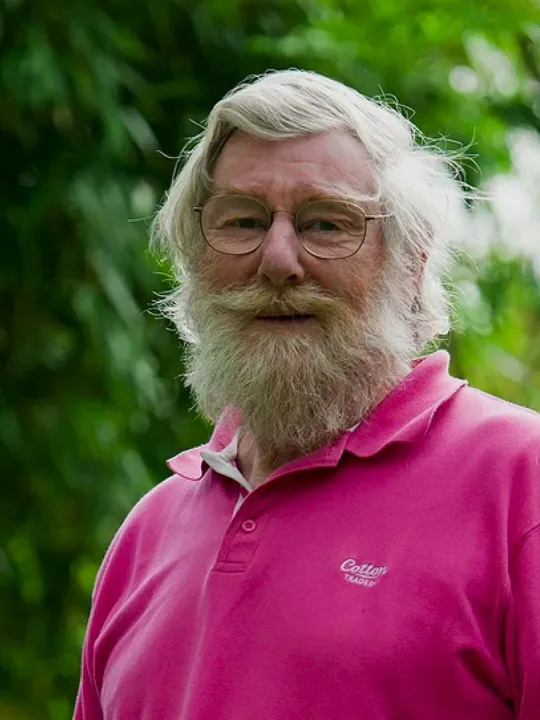
Peter Aldington, OBE
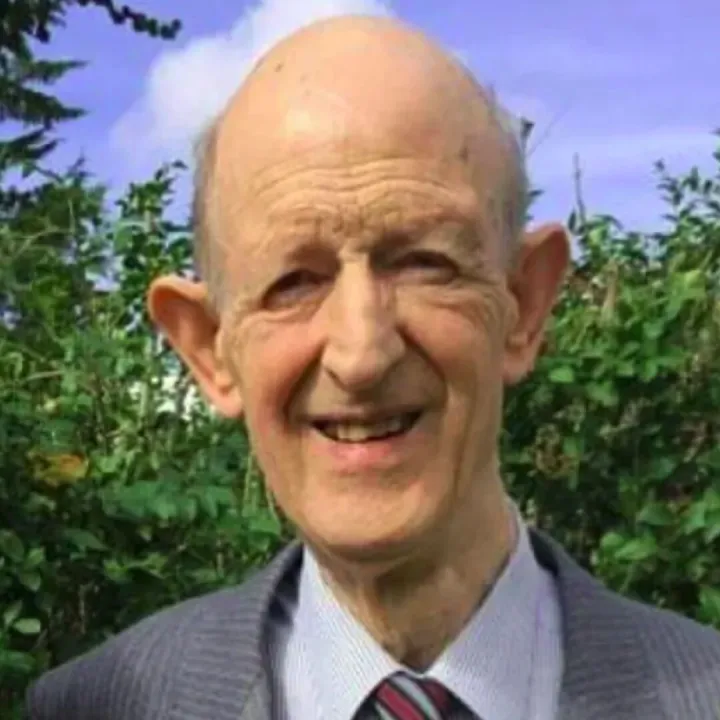
It is with great sadness that we share news of the death of local resident and renoun architect, Peter Aldington, who passed away on 15th April 2026 aged 93.
Peter was a remarkable architect whose work reflected a lifelong commitment to the relationship between buildings and the landscapes that surround them. His legacy will live on in the buildings he so thoughtfully crafted and in the generations of architects his work has inspired.
The following is a tribute published in the Architects' Journal
Preston-born Aldington rose to prominence in the 1960s and 70s, working on a series of domestic projects that blended the interiors with their gardens. Nine of his buildings have been listed – more than any other post-war architect.
His most famous work, Turn End, was built for his family and received an RIBA Award for Architecture in 1970. The scheme, consisting of three houses and a garden in the village of Haddenham, Buckinghamshire, was upgraded to Grade II* status in 2006.
Photographs of Turn End and the sister houses Middle Turn and The Turn were published across the world. His practice Aldington and Craig, later Aldington Craig and Collinge, was based in the house until relocating to a converted Victorian bakery on a neighbouring site in 1979.
Aldington first qualified in 1956 after studying at Manchester University School of Architecture. He worked for London County Council
Architects Department, then for the Timber Research Development Association, prior to launching his own practice in 1963.
But he retired from the profession 23 years later at the age of 53 to focus on garden design. He was awarded an OBE in 1986.
Former RIBA president Sunand Prasad told the AJ: ‘Peter exemplified integrity in architecture.
‘Integrity of materials and space, of detail and concept, of buildings and landscape, house and garden – even architecture and architect, because you can’t separate the man from the work.
‘The houses are like built versions of his honest, curious, kindly and unbending personality.’
Architect John Pardey, who worked on an RIBA-published book with Aldington about his house designs, commented that he was ‘a
bit gruff at first but beneath was a warm, lovely family man who had quite a big teddy bear collection. I will miss him very much.’
He added: ‘I was also intrigued how he could have turned his back on architecture at the age of 53 when he clearly loved it so much – it seemed he was just not willing to compromise.’
Daniel Marmot, co-founder of London-based studio Artefact, said meeting Aldington in 2018 had a ‘profound influence’ on his
thinking about architecture and its ‘relationship to gardens and landscape’.
Writing on LinkedIn, he said: ‘He seemed refreshingly unbothered by the critical re-engagement with his work, and it was clear
he had a deep integrity that is evident in his designs. The work clearly mattered far more to him than reputation.
‘He leaves a legacy of timeless buildings and ideas that continue to influence us and our students, and is a quiet hero of late
20th-century architecture in the UK.’
Deborah Saunt, co-founder of London-based practice DSDHA, said the influence of Aldington’s practice’s works on her was ‘palpable’ as she grew up in Buckinghamshire.
She said she had the ‘privilege of meeting Peter in his house with his wonderful wife Margaret and seeing them together in the beautiful home’. She told the AJ: ‘The very first house I designed in college was ahomage to theirs, with courtyard gardens and high walls, set about a forecourt shared with other homes.’
‘The reason his work is so resonant for me is that he had an extraordinary ability to combine both home and garden with a beautiful
transition of layered degrees of public and private space, and this has acted as a model for all scales of work, either rural or urban.’
Twentieth Century Society chair Hugh Pearman said Aldington was part of the same generation of ‘meticulous, hands-on’ architects as Ted Cullinan, with his work a ‘synthesis of modern and traditional forms in sensitive locations’.
He added: ‘His practice’s work was stylistically surprisingly broad, including hard-edge Modernism and even High-Tech. What he will be remembered for above all, however, is his understanding of domesticity and his remarkable craftsmanship.’
Speaking about his work, in a clip on the Turn End website, he said: ‘You can’t put a building in a space without radically affecting that space you have put it in. I don’t think there is a building design and outside design; the whole thing is bound to cohere as one, whether you like it or not.’
His other housing work includes Diggs Field, Clayton House, Lyde End and Askett Green, all in Buckinghamshire, as well as Anderton House, in Barnstaple, Devon, and Wedgwood House, in Suffolk – all of which are Grade II listed.
Richard Murphy of Richard Murphy Architects said Aldington’s houses sat ‘in contrast to the unspeakable horrors of the standard British housing estate, and are a triumph of how housing can be both utterly contemporary in design but at the time contribute powerfully to local traditions’.
He added: ‘Every planner and every housing developer should be compulsorily taken to see them.’
Aldington died on 15th April, a day after his 93rd birthday and just two months after the death of his former partner, Paul Collinge. He leaves his wife Margaret and their two daughters.