Gross Expansion of Haddenham?
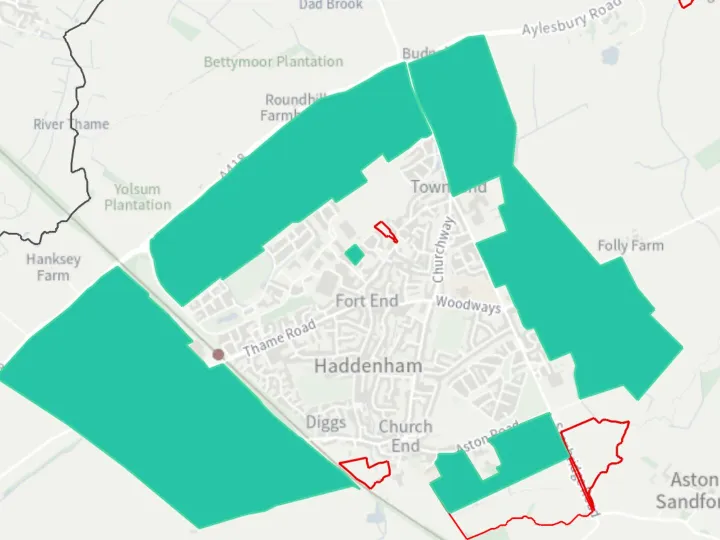
Buckinghamshire Council has just published the development sites review exercise and green belt report.
See the New & Expanded Settlements Study, and read the chapter on Haddenham beginning on page 61.
Then weep when you see that three primary sites are identified for new homes, with a potential capacity for 7,350 properties, and 5,000 seriously being considered.
Residents can offer their comments here
Councillor Maru Mormina has written to the Cabinet Member for Planning
Here is the text of her commentary:
I am writing to set out my views and expectations on behalf of the community I represent. Recent council briefings have clarified the implications of the current iteration of the Local Plan for Haddenham and its surrounding area.
Under the proposals as currently understood, Haddenham — and to a lesser extent other settlements in my ward— is expected to accommodate a very substantial proportion of the county’s growth. If all sites presently under consideration are deemed suitable, this would amount to approximately 5,000 new homes. Such an increase would effectively triple the population and transform Haddenham from a village into a town.
Haddenham sits within Tier 3 of the settlement hierarchy, defined as “towns and other large settlements which have most of the services and facilities, at least five employment premises and good public transport.” It is therefore treated as a highly sustainable location for development and has already absorbed growth well beyond the allocation set out in the now superseded Vale of Aylesbury Local Plan (VALP).
However, the concept of sustainability is poorly defined across the emerging Local Plan. Even the interim Sustainability Appraisal (August 2025) does not articulate a clear or coherent framework for how sustainability — a composite concept requiring the balancing of multiple trade-offs — is being interpreted. In practice, the current approach appears to rely heavily on transport connectivity and assumptions about access to services, facilities, and local employment. This is a narrow and insufficiently examined understanding of sustainability.
It is inevitable, and I am sure you anticipate this too, that the scale of expansion proposed will cause significant concern among residents. These concerns arise from the disconnect between the theoretical sustainability assumed in planning decisions and the lived reality of those who experience daily the consequences of development that has proceeded without a substantive understanding of the physical, social, and environmental limits of the area. What is “potentially” sustainable on paper is not necessarily sustainable in practice.
As the ward councillor, my responsibility is to represent the community and advocate for their interests. I support the principle of delivering affordable, high quality housing. However, for development to genuinely benefit Haddenham, it must be accompanied by a credible, comprehensive, and deliverable infrastructure strategy. At present, I have little reassurance that such a strategy exists.
Reliance on S106 and CIL contributions is inadequate: S106 mitigates only the incremental impact of individual sites, not the cumulative impact of multiple large developments; and much of the required infrastructure must be delivered upfront, long before contributions become payable. At a minimum, the community will expect a clear shift away from dependence on S106 and towards a more strategic, front-loaded approach to infrastructure funding.
Equally, the community must be meaningfully and democratically involved in identifying infrastructure needs and shaping the future of the settlement. This requires more than statutory consultation. It means respecting the Neighbourhood Plan, engaging directly with residents, and valuing local knowledge alongside technical assessments.
Too often, decisions are made from a position of informational deficiency, with local insight treated as secondary to remote expertise. As a first step, I invite you both to visit Haddenham, meet residents, and hear directly their concerns, expectations and aspirations for the future. I appreciate the national policy context within which the draft Local Plan must be prepared, and I will continue to help residents understand that context.
However, I must also question — as I expect the community will — Buckinghamshire Council’s acceptance of the housing requirements generated by the Standard Method, and the reluctance to challenge targets that appear incompatible with deliverability, affordability, current market conditions, and the wider economic climate, including land values, labour availability, and materials costs.
There are also potential conflicts with other statutory duties, including climate and biodiversity obligations, flood risk management, and heritage protection. Proceeding without a transparent and participatory process to address these tensions risks undermining public trust and jeopardising the aim of the Local Plan of sustainably meeting local housing needs. It is essential that the Council demonstrates it has robustly tested the housing requirement and is prepared to challenge it where it is not realistically achievable or consistent with its statutory responsibilities.
Dr Maru Mormina (Cllr)Buckinghamshire Council
Email: Maru.Mormina@buckinghamshire.gov.uk
Tel: +44 7356 226513
Representing the ward of Haddenham and Stone